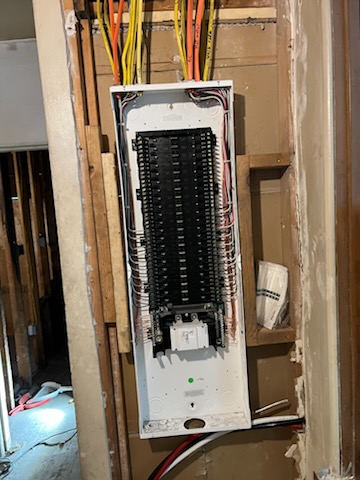
Home Rewiring and New Circuits in McKeesport, PA
Electric Power Pro Solutions handles rewiring and circuit work across Greater Pittsburgh — from a single overloaded run to a house that hasn't been touched in decades — with every job permitted, inspected, and sized for what you actually need.
What Drives Rewiring and Circuit Needs in the Mon Valley
A large share of the housing stock in McKeesport and surrounding Mon Valley communities — Duquesne, Clairton, Glassport, White Oak — was built between the 1920s and 1950s. Homes from that era were wired for 30 to 60 amps of total service, which was reasonable when a household's biggest electrical load was a refrigerator and a few lamps. Today a single EV charger, central air unit, or induction range can exceed the capacity of an entire original service entrance.
Allegheny County municipalities require permits for rewiring work and for the addition of new branch circuits. The permit triggers an inspection, and the inspection is what closes the loop — it's the document that shows up in a title search, satisfies an insurance underwriter, or holds up at a home inspection. Work done without a permit doesn't disappear; it surfaces at the worst possible time.
Older Pittsburgh-area homes also present specific wiring conditions inspectors flag regularly: knob-and-tube wiring that has been buried under insulation (a fire and insurance risk), aluminum branch-circuit wiring from the late 1960s and 70s requiring proper termination or replacement, and two-slot ungrounded outlets throughout the house. Each of those conditions has a defined code remedy, and we follow the remedy rather than patch around it.
- Knob-and-tube wiring: common in pre-1950 McKeesport and Mon Valley homes — not automatically a crisis, but not insurable once covered by insulation
- Aluminum branch wiring (1965–1973 construction): requires CO/ALR-rated devices or pig-tailing with approved connectors
- Ungrounded two-slot outlets: replaceable with GFCI protection per NEC 406.4(D) without running new ground wire in every case
- Permit required in Allegheny County for new circuits and full or partial rewires — we pull it, schedule the inspection, and hand you the paperwork
How to Know Whether You Need a Rewire, New Circuits, or Something Smaller
The answer usually comes down to what the house is doing versus what the wiring can actually support. Breakers that trip under normal loads, outlets that are warm to the touch, lights that dim when an appliance kicks on, a panel with no open slots — these are capacity and condition signals, not random nuisances. A full rewire is the right call when the existing wiring is unsafe by type (knob-and-tube under insulation, deteriorated cloth-jacketed wire), too old to reliably trace, or so extensively modified without permits that starting clean is faster and safer than mapping what's there.
New dedicated circuits solve a narrower problem: you're adding a load — a range, a dryer, an EV charger, a workshop subpanel — that the existing system doesn't have a home for. Kitchens under current code require a minimum of two small-appliance circuits on top of any dedicated appliance runs; a kitchen remodel almost always means new circuit work regardless of how old the house is.
When you call, describe what the house is doing. We'll tell you whether it warrants a full rewire, a few new circuits, a panel upgrade, or nothing at all.
- Breakers tripping under ordinary household loads — capacity or wiring condition issue
- No open breaker slots — panel upgrade or subpanel needed before new circuits can be added
- Kitchen or laundry remodel — code requires dedicated circuits; existing wiring rarely qualifies
- Home inspector flagged wiring — we read the report and address the specific findings, not a generic fix
Common questions
- How much does it cost to rewire a house in the Pittsburgh area?
- The range is wide because the variables are wide — square footage, number of floors, finished versus unfinished walls, existing panel condition, and local permit fees all affect the number. A partial rewire of a single floor in an older McKeesport row house is a different job than a full rewire of a two-story colonial in a newer Westmoreland County suburb. We look at the house in person and give you one written number covering labor, materials, permit, and inspection before anything starts. The estimate is free.
- Can I add a new circuit without upgrading my panel?
- Only if the panel has an open slot and the service amperage is sufficient to support the new load. A 100-amp panel running a full modern house is often already at capacity; adding a 50-amp circuit for an EV charger or range on top of that isn't safe or code-compliant. We check both the available capacity and the physical slot count before recommending whether a new circuit alone is enough or whether a panel upgrade needs to come first.
- My home inspector found knob-and-tube wiring. Do I have to replace all of it?
- Not necessarily all of it, but the conditions that make it a problem need to be corrected. Knob-and-tube that is accessible, unmodified, and not covered by insulation can sometimes remain in place under certain local interpretations — but insurers are increasingly refusing to cover homes that have it at all. If it has been spliced into with modern wire, covered with blown-in insulation, or run through areas with heat sources, replacement is the correct answer. We'll look at what's actually there and tell you what the inspection findings mean in practical terms.
Tell us what the house is doing
Describe the problem — tripping breakers, a remodel that needs new circuits, wiring an inspector flagged — and we'll give you a straight answer and a free written estimate.
Call not on file